 Rene Ouellet was a Canadian transsexual who had disappeared in June of 1992, almost immediately after he had begun working as a female impersonator at a bar called the Fun Spot in West Wildwood. I had been living on the island for a month when this occurred, and I remembered it because Ouellet’s apartment had been located on the same Davis Avenue block where I spent my free time. “MISSING” several street-pole flyers read, followed by Ouellet’s full name and stage name (“Michelle”). There was a photo featuring a thin man dressed in drag wearing a lopsided wig. This man looked like Michael Jeter’s mustachioed cabaret singer from The Fisher King, so much so that I had posted a copy of that flyer in the beach house where we drank.
Thirteen days after Ouellet’s disappearance, an old man sweeping the beach with a metal detector discovered the Montreal native’s body. It had been hidden inside an alcove beneath the Montgomery Avenue bandshell. Ouellet had suffered a beating; blunt-force trauma to the head, forearms and torso. Ouellet’s lungs were overrun with sand, rendering the official cause of death to be asphyxiation. Rumor had it the old man’s metal detector had zeroed in on Ouellet’s wristwatch, thereby minimizing any chance that this had been a robbery turned ugly. Ouellet had last been seen wandering east toward the beach with an unidentified male at 2:30 in the morning. Collective evidence suggested that it was this male who had fatally assaulted Ouellet, before returning to camouflage the body a short time later.
Media coverage of Ouellet’s murder began to dissipate toward the end of that September. Years passed, and the case went cold. Cape May County had all but forgotten about Ouellet until police received an anonymous tip during the winter of 1996. From that point forward, investigators shifted their attention toward Brian Halter – a 24-year old who had been working as a Wildwood lifeguard during the summer that Ouellet had been killed. Halter was arrested on June 26, 1996; nearly four years to the day after Ouellet first disappeared.
Under interrogation, Halter insisted he had passed out on the beach after a long night of drinking, waking up to find Ouellet performing oral sex on him. Brimming with rage, Halter had begun to punch Ouellet, prior to beating on the 30-year-old via the broad side of a board. Once Ouellet proved unresponsive, Halter covered up the body with sand. Halter left, but then returned, at which point he discovered Ouellet elbowing his way out of the ground. Halter pummeled Ouellet; he strangled him. He dragged the body to a nearby enclosure, where he re-covered it with sand before deserting it once more.
From an outsider’s perspective, Halter’s perp-as-victim angle appeared remarkably convenient. Lifeguards were known to pass out on the beach (an effective way of ensuring that they could make it into work), but the idea of a transsexual taking it upon himself to spontaneously begin blowing somebody … well, it kind of screamed to the most insecurely heterosexual of males that, “Given the circumstances, you might’ve done the same thing.” The more reasonable assumption – an assumption that would’ve connected several of the ill-connected pieces – involved a drunken Halter meeting Ouellet out on the streets. This sort of thing occurred throughout every summer, and it would’ve accounted for the “unidentified male” whom Ouellet had last been seen accompanying toward the boardwalk. Perhaps Ouellet had dropped some hint about being a man; perhaps not. Perhaps an inebriated Brian Halter had proven too oblivious to notice. Regardless, there was ample reason to believe that the two of them had disappeared underneath of that promenade consensually.
In August of 1997 Brian Halter pleaded guilty, effectively downgrading an original charge of first-degree murder into aggravated manslaughter. Three months later, on November 3rd, the 25-year-old was sentenced to 15 years in prison. He would be eligible for parole in a year and a half.
***
On the day after Halter’s sentencing, the City of Wildwood voted in favor of an ordinance that would roll back the closing times at neighborhood bars from 5 AM during the summertime to 3 AM, year-round. This decision had been a long time coming, an unnecessary byproduct of the February beating that had resulted in John Vollrath’s death. Vollrath’s attackers remained free on bail, their sentencing postponed. Club Kaladu – the establishment where Vollrath and his attackers first clashed – had been shut down, its liquor license revoked.
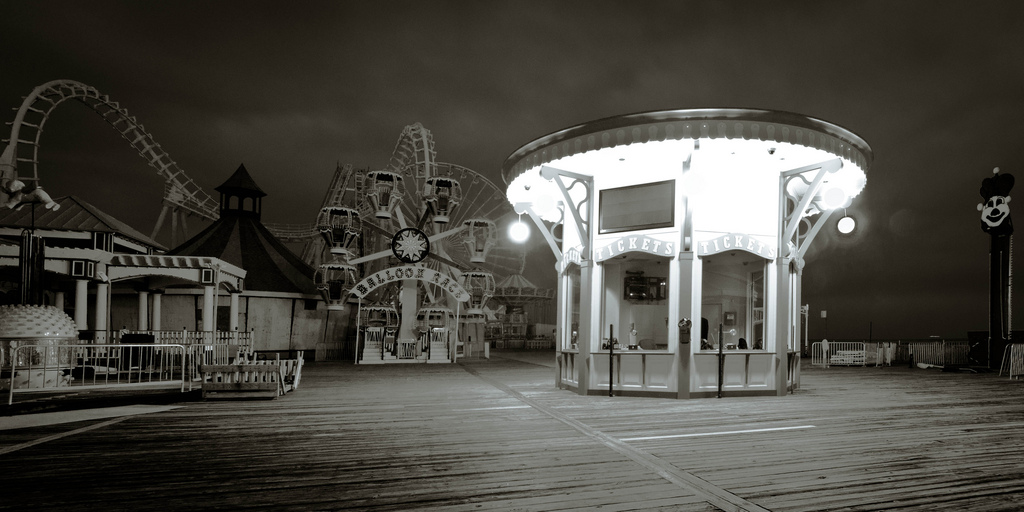
Club Kaladu was located along the southeast corner of Schellenger and Pacific – a commercial intersection that unfurled much like a crucible. Schellenger’s Y axis came buffeted by a Ferris wheel along one end, and a two-block spate of projects along the other. Schellenger was home to Mariner’s Landing and Midway Pier, Castle Dracula and The Landmark Motel. But it was also home to the Stardust Nightclub, the Hurricane Strip Club, and the seafood restaurant behind which Susan Negersmith’s body had been found. Pacific Avenue intersected Schellenger about its midsection, running north to south from 26th Street all the way through Wildwood Crest. The Pacific Street Mall – perennially recognized as the centrifuge of Wildwood’s nightlife district – boasted the same red-brick walkway as Cape May’s Washington Street Mall. Over time the two had been rendered as a fascinating study in the impact of socioeconomic development on architectural design.
This was not so much indicative of a year-to-year struggle as it was a decade in decline. The 1990s in The City of Wildwood had started off with what appeared to be a municipal cover-up (200 meters east along Schellenger Avenue) before disintegrating into a wave of violence that included at least 10 murders in less than seven years (independent of Wildwood Crest and North Wildwood). Compare that with four murders within the city limits throughout the 1980s and a feeling of animus began to take hold. Tourism was down; the city’s poverty rate kept rising. Wildwood at large had gone from being an enjoyable punchline to pretending as if it weren’t in on the joke. Throughout that November, wherever one stood, regardless of whether he were one of the 125,000 who had made up Wildwood’s height-of-season population or one of the 5,500 who had remained there throughout winter, regardless of whether he were in favor of a 5 AM closing time or opposed, in favor of a hospitality tax or beach tags, budget cuts or a multi-million-dollar casino; regardless of whether he were Kent Negersmith insisting on justice for his daughter or John Vollrath, Sr. demanding justice for his son; regardless of whether he were applauding the incarceration of Brian Halter or denigrating the alternative lifestyle of Rene Ouellet, the fact remained that everyone – and I mean everyone – along Five-Mile Island had taken to accusing everyone else of having ulterior motives. Amid the empty streets, the weather-beaten porches, there were scarecrows missing faces now, slow-rotting pumpkins on the corners. The holiday season was approaching. An opportunity for order.
Day 1,354
(Moving On is a regular feature on IFB.)