Click through for full-size gallery.
Category Archives: Uncategorized
The Innocent & The Damned
Click through for full-size gallery.
Film Capsule: The Art of The Steal
Last night I watched The Spanish Prisoner, and was reminded of this truth regarding David Mamet’s heist films: There are always gaping plot holes, and those holes don’t seem to matter. This is the result of first-class writing, taut suspense, and a storyline much broader than the flaws inside its wake.
Art of The Steal is not a David Mamet movie. But it is a mainstream heist film … one so caught up in its own conceit it squanders all its currency on improv. At its center is a takedown crew, completely capable of world-class scores. Only Jonathan Sobol turns his lead cast into morons, bumbling through a bloated script that’s overrun with trite cliches. Set along the all-time heist movies – The Killing, Dog Day Afternoon, Thief, Quick Change, Reservoir Dogs, The Usual Suspects, Heat, The Score, Inside Man, The Prestige and Before The Devil Knows You’re Dead – Art of The Steal is nothing more than methane gas and white noise. It approaches every plot twist like a pratfall, posing set-ups with the bombast of a slick peel on the ground.
Editor’s Note: Kurt Russell plays a character named Crunch in this movie, adding to a resume that boasts the likes of Stuntman Mike, Bull, Snake, Cash and … Snake.
(Art of The Steal opens in limited release this Friday.)
Henry Miller on Writing About The Immoral (1975)
“One reason why I have stressed so much the immoral, the wicked, the ugly, the cruel in my work is because I wanted others to know how valuable these are, how equally if not more important than the good things … I was getting the poison out of my system. Curiously enough, this poison had a tonic effect for others. It was as if I had
given them some type of immunity.”
(Excerpted from the Rolling Stone article, “Reflections of a Cosmic Tourist“)
‘True Detective’: A Working Theory
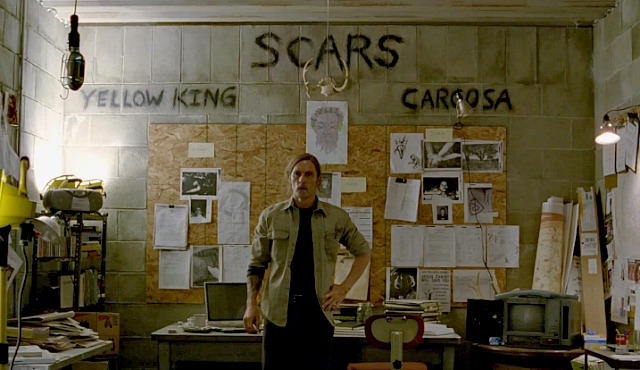 (Please Note: Spoilers abound. If you’re not up to date, probably best to hold off.)
The entire thing’s laid out bare during that “throwdown in the woods” – murder, mayhem, mystics, a pair of unreliable narrators … sex, death, dosing, drugs, a war-time jungle full of tripwires. This is True Detective making its real intentions known – six is nine and up is down … the world has blurred both right and wrong.
Carcosa, The Yellow King, a corpse with antlers, the Man With Scars … True Detective represents a bold new level in anthology, one solution to a problem that’s plaguing good TV for several years. Namely, what does one do after the mystery’s exhausted? Well, assuming you’re the producers of True Detective, American Horror Story, or even the upcoming Fargo, the good news is, renewal’s part of the equation. The bad news is, no brilliant character lasts long.
In that spirit, the eight-week odyssey of Rustin Cohle – and, by extension, Martin Hart – will come to an end this Sunday evening. A tragedy if for no other reason then we’ve learned so little about Rust Cohle. His records are redacted, his memory astir, his daughter’s death’s labeled a blessing, despite the fact we’re still unclear as to what occurred.
We first meet Cohle working a crime scene, the ritual murder back in 1995. We quickly learn that he’s obsessive, intellectual, convinced of nothing but his own beliefs. We learn that Cohle’s a skeptic, anti-Christian, that he meditates about surrender in Gethsemane. We learn that Cohle’s methodical, amphibian, capable of manipulating any motive toward his purpose. He’s positioned as a martyr, an anti-hero, a pair of archetypes we’ve been conditioned to adore. He’s got no past, no home, no family, no account of where he’s been between late childhood and 30 (nudge, nudge). His arrival in Louisiana sets the earth on fire, linking God and Satan’s fury to a murder in the woods.
What we’re looking at is one man’s creation of a bogeyman, an imaginary monster inciting fear as control.
Consider Marty Hart, a southern Christian (like both proven victims), prepared to place his faith in Cohle once more. Marty now resembles Cohle – detached from his profession, forever estranged from both his wife and daughters. Rust Cohle played a major part in that, quietly stripping Hart of all he owned. Worst of all, he’s got poor Marty back to drinking, slow-dosing him with subterfuge toward a big fall down the road.
What we may be gearing up for is the coup de grace of one man’s long crusade – a holy war against religion, against a God who’s led mankind astray. It’s a commentary on our culture, on the manufacturing of monsters as a means of mass control. And you can bet Rust Cohle will find himself inside Gethsemane, where he’ll surrender to the guards once more.
(The final episode of True Detective: Season One premieres Sunday at 9 pm on HBO.)
Paul Thomas Anderson on Dropping Out of Film School (1999)
“I enrolled in NYU and I went there for literally two days. What happened was I walked into this class and this teacher said, ‘If anyone is here to write Terminator 2, just walk out … just get right out the door.’ And I thought, That’s not a good way to start. What if I do want to write Terminator 2? What if someone sitting next to me wants to write it? Y’know, you’re sort of instantly saying, ‘We write serious films here.’ Well, Terminator 2‘s a pretty awesome movie. So there was an assignment to write a page that has no dialogue in it, but you gotta make sure that you explain something about a character – you show a character trait through action, with no dialogue. And I had read this great script by David Mamet, which was Hoffa, which was not yet made at the time. And there was a great scene that Mamet had written where Danny DeVito’s character is driving along, and it shows what he’s going through by the method he’s using to keep himself awake while driving, which is he lights a cigarette and he holds it between his hands and he lets it burn down to his fingers to keep himself awake. It’s just so perfect and simple and lovely, and it’s Mr. Pulitzer Prize himself, David Mamet. So I took that page and I handed it in. And it got a C+. And I said, ‘Well, now I know I’m right.’ And it’s a wonderful thing that if you drop out quick enough you can get your tuition back. So I had this money that my father had given me, and I just sort of lived off that and made a short film.”
(Excerpted from the Elvis Mitchell interview.)
Jerry Seinfeld Really, Really, REALLY Wants You To Recognize Him As a Great Stand-Up Comedian
Last Tuesday, Jerry Seinfeld performed a brief five-minute set on Jimmy Fallon’s new Tonight Show. The material was milquetoast (“What’s the deal with cellphones?” “How outdated is the Post Office?”); the reception, mediocre. And yet, the only thing that mattered was significance – Jerry Seinfeld, a man who credits Johnny Carson with putting him on the map, appearing as the first-ever stand-up comedian on a brand new iteration of The Tonight Show (an iteration that returned the vaunted franchise to New York, no less).
As far as Jerry Seinfeld was concerned, this appearance represented a coup, a lark, a resume builder for the man who needs no introduction. More to the point, Jerry’s Tonight Show appearance represented the latest in an ongoing string of career moves aimed at reinforcing a point. Namely, that Jerry Seinfeld sees himself as the platinum standard in comedians, and he’d like it very much if the general public would agree.
The problem isn’t Seinfeld’s dedication. He’s been a constant on the stand-up circuit for well over 30 years. He can sell out an auditorium, he can kill inside a night club. And yet his public persona will forever be linked to some amped-up version of himself presented via the most popular – if not quotable – situation comedy of all-time.
Forget about the fact that Jerry Seinfeld co-founded and co-wrote that treasured sitcom, that Seinfeld‘s still a juggernaut in syndication. Forget about the fact that Seinfeld overcame a dreaded laugh track, that it was the last great network comedy to maintain a spot atop the ratings. What people will – and do – remember is that character – Jerry. Jerry, the straight man, Jerry, the neighbor, Del Boca Vista Jerry, Uromysitisis Jerry, These-Pretzels-Are-Making-Me-Thirsty Jerry.
Jerry.
Jerry. Jerry. Jerry. Jerry.
Jerry.
Not the stand-up Jerry whose passing bits were used as bumpers. Not the stand-up Jerry who feels under-appreciated as a comic. Not the Jerry who, at the height of his sitcom’s popularity, released a cobbled-together collection of old bits entitled SeinLanguage. Not the Jerry who embarked upon a whirlwind tour during the same year as Seinfeld‘s curtain call. Not the Jerry who was the focus of a 2002 documentary entitled Comedian. Not the Jerry who agreed to host several seasons of Comedians In Cars Getting Coffee. Not the Jerry who did a 2012 video piece for the New York Times entitled “How to Write a Joke“. Not the Jerry who very recently followed that piece up with an interview entitled (get this), The Ballad of Leno and Letterman, Told by Seinfeld.
No, sir. Stand-up Jerry … now that’s another Jerry entirely. Continue reading
Do Justly, Love Mercy, Walk Humbly With Thy God
Click through for full-size gallery.
Moving On: Graduation
 It had been an average prom as far as such things go – the police chief’s daughter showed up wasted, the would-be queen ran out in tears. The kids danced fast, the kids danced slow, third-generation stalwarts from The Starlight Ballroom. I spent the evening by a dry bar, a constant bridge between what is and what should never be. No one would’ve cared that I was 21, assuming I was charming, or chiseled, or my default vibe was anything beyond “fuck you”.
Either way, the prom was over now, and the after-prom was in full-swing. I stood alone inside a two-room suite, staring out across backyards. I should just go home, I reasoned. I live two fucking blocks from here.
My girlfriend had run downstairs for 15 minutes. That was a little over an hour ago.
I filled a book bag full of beer, headed downstairs to the commons. I leaned my weight against the guardrail, stealing glances from above. I moved from Tina Bada to Alanna, Steve Del Monte, Dave Del Conte … the entire class of 1995. All except for my young girlfriend, who had vanished like a sneak thief in the night.
“She’s probably waiting upstairs in your room,” one senior offered. “You should just go back and wait,” another added. I grew anxious, and then surly, then impetuous enough that my false dread gave way to anger. I doubled back up to our bedroom, down again into the commons.
The crowd was loose and thinning now; the conversation, drowsy. I sat alone along the stairwell, scanning Crescent Court from side to side. There was a door along the northeast wall, a strip of light amidst dark shadows. I wandered down across the lobby, put my ear up to the panel. I rapped the door with peaked knuckles, forced the issue till it opened.
I stood alone inside an archway, staring blankly at my girlfriend. We were three inside a room for two now, and three meant one person too many.
***
Jimmy. Meghan was holed up in that private room with Goddamn Fucking Jimmy. Gorgeous, blue-eyed, peach-fuzz Jimmy, with the flop-sweat blotches and the pristine hair. Jimmy, with the spit-shine smile and the stylish mole. Jimmy, the all-county athlete; Jimmy, the all-catholic boy. Jimmy, the coulda-been-shoulda-been-but-never-was best friend; the guy who Meghan held a torch for right up until she first met me.
Jimmy was the platinum standard, safe and secure, family-friendly to an embarrassing degree. Jimmy was the same age and same year as Meghan, honor roll, en route to college. Jimmy made Meghan laugh despite not being funny, and he shared Meghan’s assessment that a window in their lives was closing. Only Jimmy had a girlfriend, and Meghan had a boyfriend, and the entire thing felt awkward, like some subplot from Sweet Valley High.
All of which explains my sense of letdown upon entering that room. I’d witnessed nothing compromising … no fragrante delicto, so to speak. And yet, it was obvious I had wandered in on something, a pair of kindreds acting in accordance with some now-or-never principle, perhaps. In the end I could not say for sure, save for the fact the two of of them were sequestered … at 4 am … on prom night … for well over an hour … half-potted … having abandoned their respective dates.
The prevailing wisdom had it pegged that I was jealous, an outsider, the jilted boyfriend full of vitriol. There had been incidents – an entire litany of them – to support this argument. Over the course of two long years I had grown overbearing to an extent I regularly guilted Meghan into skipping routine outings with her friends. Excuses ranged from not wanting her to get arrested for drinking to flat-out shitting on her closest buddies. Every emotional response came plagued by insecurity – acute fear of losing Meghan to the next best thing that came along.
On the morning of Meghan’s sister’s funeral – way back in 1993 – I threw a fit upon discovering Jimmy would be arriving at the service before I did. It’s not his place, I stammered, it makes no fucking sense. Half-an-hour worth of pretzel logic, neatly wrapped inside some myth about the all-American boy in his all-American suit, masquerading as a surrogate for me – the mingy, doe-eyed dropout, wearing hand-me-downs from relatives.
By May of 1995, Meghan knew that she could do much better. Consequently, she had settled in as a lame duck, irretrievably committed to either riding matters out until September – at which point she’d be leaving for Immaculata – or accepting severance terms along the way. The last time we’d had sex was somewhere back in mid-December, an unmemorable event that came and went on Meghan’s kitchen floor. Ever since, mon cheri appeared repulsed by me, so much so that provocation proved no asset. Meghan no longer cared about the winning or losing. Meghan no longer cared about the anything at all.
***
Meghan’s graduation took place in the evening, during that auburn hour when the sunlight’s slowly fading like so much yolk into the bay. Twilight shadows fell at angles, stretching out like dueling lances. There were gowns, a glowing stream of gowns, Atlantic Avenue lit up in satin. I was wearing the same suit that I’d had on when Meghan’s sister died, and it reminded me of being with Meghan on that morning. Long-term, that incident had drawn the two of us much closer. Only now the weight had shifted, forcing stress upon the whole.
I walked home after the graduation, changed into denim jeans and a T-shirt. Meghan pulled up out front an hour later, motor running, car in park.
“I’m heading to a party,” Meghan told me.
“Oh, wow,” I said. “OK. Well, just let me grab some beer and the two of us can … ”
“You can’t,” Meghan commanded. “It’s seniors only. Not my call.”
Silence. The sound of asphalt under foot.
“How long have you known?” I wondered.
“How long have I known what?” Meghan asked.
“How long have you known about this party?”
“An hour,” Meghan responded. “Maybe two.”
“What about Orlando?” I said.
“What about Orlando?” Meghan soured.
“We’re supposed to be leaving for Orlando tomorrow morning,” I said.
“So what?” Meghan told me.
“So what?” I said, mockingly. “So now you’re gonna wind up totally hungover, and I’m gonna wind up doing all the driving.”
“I’ll be fine,” Meghan insisted. “Maybe you should worry about yourself instead.”
“What the fuck is that supposed to mean?” I asked.
“Look, I gotta go,” Meghan said. “I’ll be back to pick you up tomorrow morning.”
“What time?” I said.
“Eleven.”
“Eleven?” I chortled. “I thought we were supposed to be leaving around eight?”
“OK,” Meghan conceded. “How ’bout 12?”
She flicked her cigarette out the window, leaned her elbow on the seal.
“Are we done yet?” Meghan asked.
“Will Jimmy be there?” I said.
“I don’t know, Bob,” Meghan told me.
“Oh, I’m pretty sure you do.”
Meghan tapped one finger on the mirror, exhaled a mouthful through her nose.
“Can I trust you?” I asked.
“What type of question is that?” Meghan responded.
“Can I trust you?” I repeated.
“Yes, Bob, you can trust me,” Meghan whispered. “Can I go now?”
“Promise me you won’t do anything stupid tonight,” I bargained. “Anything that might put our relationship at risk.”
“We’ve been together for two years,” Meghan berated. “How could you even propose something like that?”
“If it’s really such a given then it shouldn’t be an issue.”
“I’m not promising you anything,” Meghan said.
“You what?” I responded.
“I’m not promising you anything,” Meghan repeated. “For once in my life, I’m gonna go out and I’m gonna have a decent time and I’m not gonna end up feeling sorry for myself because of you.”
“This is fucked,” I pouted. “This is absolutely fucked. That’s what this is.”
“Yeah, well, you’ve got that right,” Meghan told me. She craned her head out through the window, leaned in to kiss me on the cheek. “I’ll see you in the morning,” she offered.
Meghan swung the gearshift, headed east toward the shore. I could hear the pistons churning, gaining strength into the turn.
Day 801
(Moving On is a regular feature on IFB.)
©Copyright Bob Hill
Galleria: ‘Save The Village’ by Fred W. McDarrah @ Steven Kasher Gallery
 Greenwich Village – a constant battle between classes, with the Old Guard all but gutted by an onslaught from the New. To this day, there are very few places that evoke a changing time so vigorously. This exhibition – featuring images by deceased Village Voice photographer Fred McDarrah – captures the iconography of that period by way of its protagonists, antagonists, outliers and queers. Here we find Robert Moses, making mincemeat of the Battery. There we find Bobby Kennedy, on a day trip to the slums. Here is Andy Warhol. There is Bobby Dylan … their times-already-changin’, preserved forever via lens.
(Save The Village continues at Kasher Gallery through March 8th, Free,
521 West 23rd Street.)
Five More For The Offing:
- The Image Gallery by Larry Siegel @ Howard Greenberg Gallery (Free, through 2/22, 41 East 57th Street, Suite 1407)
- Ambassador for the New by Ileana Sonnabend @ The Museum of Modern Art ($25 general admission, through 4/21, 11 West 53rd Street)
- Armchair Parade by Julian Crouch, Mark Stewart, Ragnar Freidank and Christophe Laudamiel @ Dillon Gallery (Free, through 3/30, 555 West 25th Street)
- Spool by Andrew Graves, Marco Palmieri and Neil Rumming @ Ana Cristea Gallery (Free, through 3/17, 521 West 26th Street)
- Supernatural by Todd James @ Sandra Gering, Inc. (Free, opens 2/27, 14 East
63rd Street)