Moving On: The End

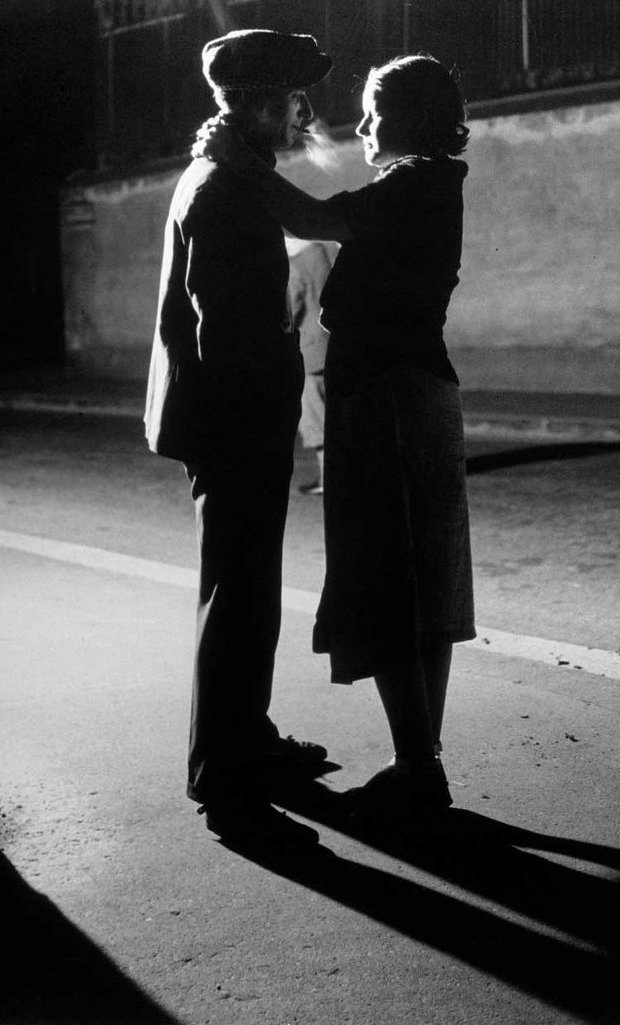
29_C-Estate-Brassa--RMN-GP_jpg_780x1243_q85I was in the living room at my parents’ house when the call came, watching television as I picked up the phone.
“Do you have a minute?” Meghan wondered. A harbinger of bad results.

I had just returned from a weekend at the shore, the final working weekend of September. We were free of it, the two of us, with Meghan settling back inside her dorm room and me eating some Cheez-Its on the living-room floor. I had spoken with Meghan face-to-face a few hours prior, had seen her walking with her father on the boards. I had asked if Meghan wanted me to follow her back to Immaculata. No need, Meghan assured me, and she said it in the way that gives old lovers pause.

“I’ve been thinking about the way that things are going,” Meghan told me over the phone. “I’ve been thinking about this whole new world that I’ve just entered, about how I’m doing everything I can to gain control. And I keep on thinking about this horrible guilt that I’ve been feeling, this overwhelming sense I might be stringing you along.”

I attempted to bargain, for a moment, but soon resigned myself to the notion this had all gone on too long. I could hear my own words spinning back to me, and – within a matter of seconds – our two-and-a-half years together had come to a close.

“Are you there?” Meghan asked me.

“Yeah, I’m here,” I quietly replied.

“I think we need to spend some time apart. Are you there?” Meghan asked me.

“Yeah, I’m here,” I quietly replied.

“Please don’t hate me.”

“I don’t hate you. Should the two of us even continue to talk?”

“I suppose it’d be best if we didn’t for a while … Please don’t hate me,” Meghan added.

“No, I promise you, I don’t.”

“I love you.”

“Yeah, I love you, too.”

“Please take care.”

Then all was lost.

Day 1,000

(Moving On is a regular feature on IFB.)

©Copyright Bob Hill

Ranking The Women In Don Draper’s Sex Life (1960-1969)

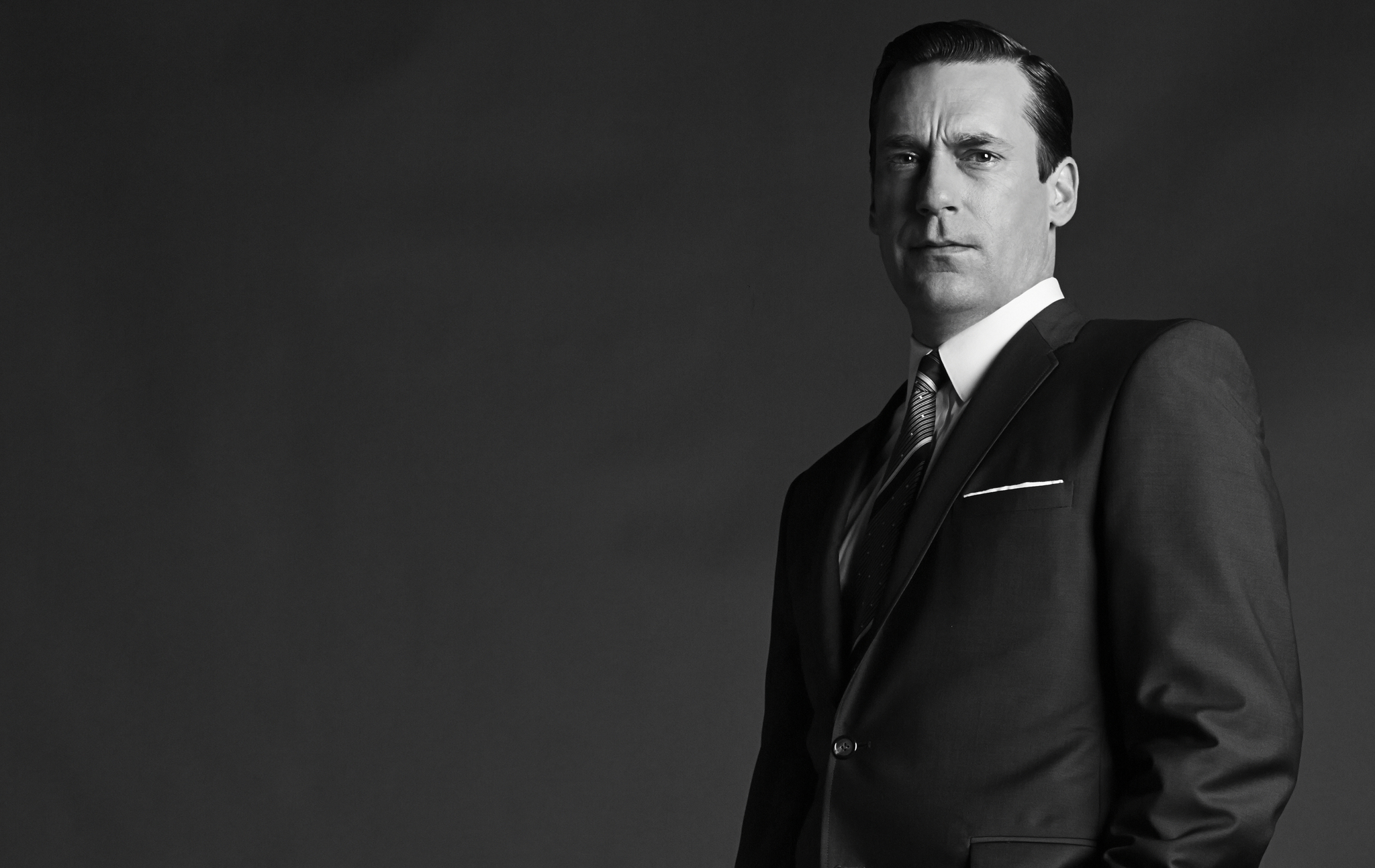
S6_Don_Draper_(01)Don Draper is a philanderer. He philanders. And though the reasons for his philandering are varied, Mad Men creator Matthew Weiner may have put his finger on it when he said, “I think Don likes longing more than he likes people who love him … His lack of loyalty runs deep because he doesn’t like the people who know him.” That is to say, we hurt the ones we love the most, but Don Draper seems intent upon punishing them. His weapon of choice: an ongoing cycle of adultery. His line of defense: implausible deniability.

As a character, Don is smart, arrogant, incredibly assured. He is wealthy, handsome … the consummate lover. Don is enough of the things that women want and men want to be that, as an audience, we tend to excuse all of his inequities. This, of course, carries over into everyday life – a capitalist culture in which rich, attractive, button-up types tend to walk all over hoi polloi.

Throughout Mad Men‘s six-and-a-half seasons, we’ve gotten to know Don, in large part, as a result of his affairs. We see Don reflected in shattered pieces of the lovers he has left behind. In ranking them, there was no consideration given to platonic relationships (no Joan or Peggy), no exceptions made for one-night stands or supernumeraries. What remains are eight eclectic women, each of them listed below based on intrigue, as well as what level of drama their interaction with Don has provided during the show:

Continue reading

Floyd Patterson on Losing (1962)

“It’s not a bad feeling when you’re knocked out. It’s a good feeling, actually. It’s not painful, just a sharp grogginess. You don’t see angels or stars: you’re on a pleasant cloud. But then this good feeling leaves you. You realize where you are, and what you’re doing there, and what has just happened to you. And what follows is a hurt, a confused hurt – not a physical hurt – it’s a hurt combined with anger; it’s a what-will-people-think hurt; it’s an ashamed-of-my-own-ability hurt. And all you want then is a hatch door in the middle of the ring – a hatch door that will open and let you fall through and land in your dressing room instead of having to get out of the ring and face those people. The worst thing about losing is having to walk out of the ring and face those people.”

(Excerpted from King of the World by David Remnick)

IFB’s Quotations Page, General Index

Moving On: When The Summer Leaves Me in September

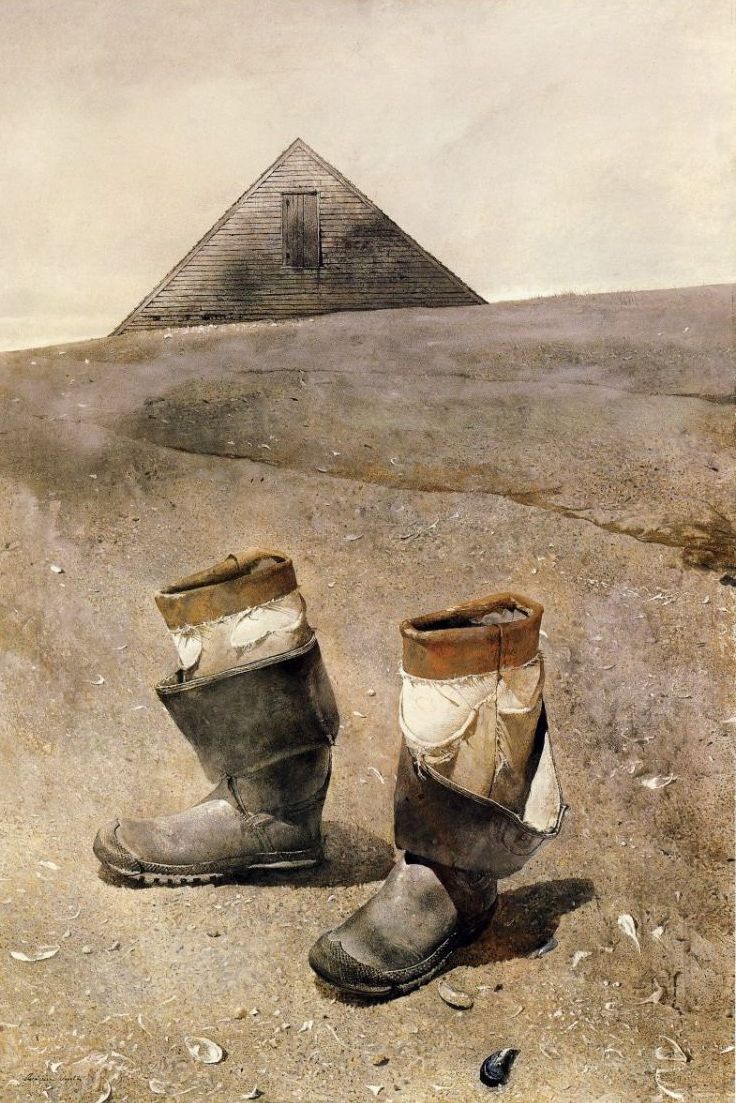
Andrew Wyeth - Sea Boots 1976When the last long week of August bled its way into September and green flies along the beach outnumbered all the worthwhile prey, when hotel balconies ran checkered and weekend vendors closed their kiosks, when short sleeves gave way to lozenges and northern trade winds curled the ocean, when the meters blinked at zero and all the street lights flashed bright yellow, when the sand began to snake its way from coastline back to inlet, that was when my girlfriend finally left North Wildwood for good.

Meghan was gone now, living in a dorm room at Immaculata, where she was campaigning for class president. We had spent the summer working apart, with Meghan managing an ice cream parlor on Magnolia Avenue while I did my thing on Surfside Pier. Most evenings, Meghan would get done just short of midnight, waving briefly as she passed me along the promenade. On a good night, she might wait for me, and the two of us would walk home together. We rarely spent days off together, and we never spent full nights. Come September, the entire thing had worn me down to an extent I scarcely ate or changed my clothes.

It was over now, or it was ending. It was just a matter of one of us stepping up to put things right.

Day 985

(Moving On is a regular feature on IFB.)

©Copyright Bob Hill

Running: How I Went From 0 to 70 In Six Weeks (& Medaled In a 5K One Week Later)

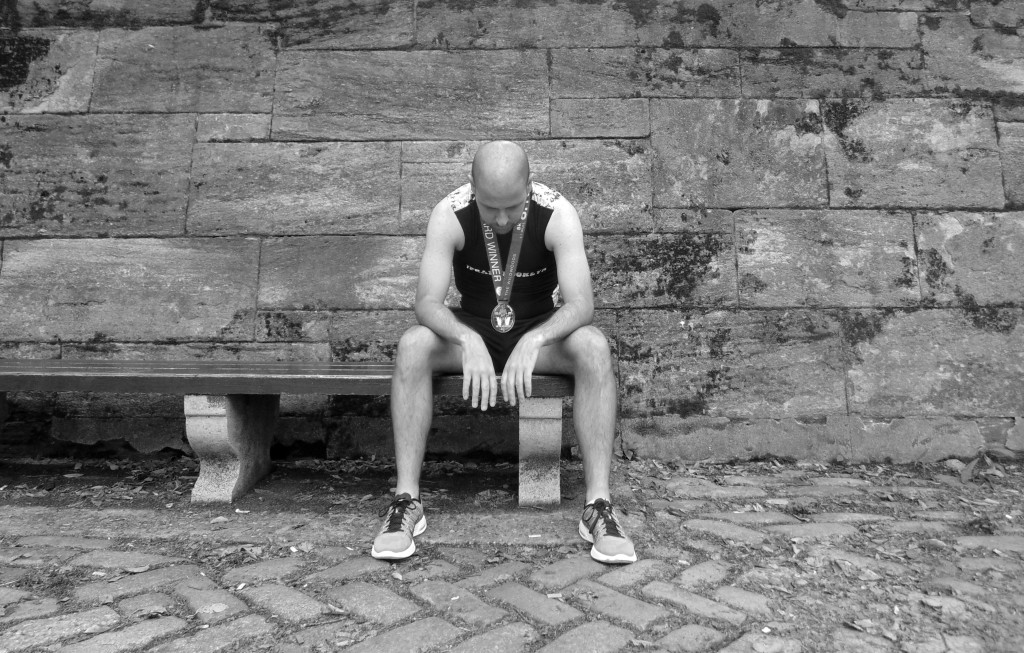
DSC03546SNAP! That is how it sounded, much more like the snapping of a car belt than the friction between fingers. I was sprinting, in mid-stride, and the jolt, it sent me tumbling, a spasm so intense I barely noticed fractured ribs. I’d pulled a hamstring, the only major running injury I’d sustained in more than 14 years. It occurred on the morning of December 8th, 2013, a month and one week after my 40th birthday.

The first week in January I was able to put significant weight on both legs. The first week in February I was able to manage a slight jog. The first week in March I pulled a muscle in my left calf; the first week in April, I pulled a muscle in my quad. The first week in May, I felt completely uninspired. I had yet to stitch together one continuous month of training. To compensate, I began reading. I read Agee and Hemingway; George Plimpton, Jesmyn Ward. At some point I even got around to reading Christopher McDougall’s Born to Run, a best-seller that introduced me to ultra-marathoner Jenn Shelton. Shelton, who has since disputed the way she is portrayed in the book, holds the women’s world record for 100-mile trail running. At 31, her tiny frame seems custom-made for uncooperative terrain. Shelton celebrates the inherent lightness in her sport, providing no sign whatsoever of the pain that she’s enduring.

Appearing in slight contrast is U.S. distance runner Shalane Flanagan. Flanagan finished second among women at the 2010 New York City Marathon (the first time she had competed at that distance). I happened to be on hand that morning, applauding as Flanagan entered the final turn – head narrowed, legs pumping, concrete abs mirroring her form. She was wearing a midriff shirt over knee socks, every limb covered in fabric to keep the rest of her warm. Flanagan discussed her approach to running on 60 Minutes this past April – a native daughter of Massachusetts, she had come home to aid the Boston Marathon’s return.

Shelton and Flanagan commanded my attention, yet they paled in comparison to 17-year-old Alana Hadley, a high school marathon runner who I’d originally become aware of as a result of The New York Times. Hadley was – and is – training for a shot at the 2016 Olympic Marathon Trials, cataloging her workouts by way of a personal blog. I had respect for Alana Hadley, particularly because her adolescent willingness to accept both triumphs and setbacks with equanimity seemed antithetical to mine.

As a child, my father was my coach, and – for a time – this proved to be an advantage. Day after day, he harnessed my ability, eventually leading me to a 32nd-place finish at the AAU cross country championships – the fourth man on a state team that took home the national title. I was 13 when that happened, and while I would continue to enjoy a certain modicum of success, it would never be like that again. By the time I entered high school, competitive running began to consume me, almost none of it occurring by choice. I was a pint-sized freshman making inroads with the varsity, but I was increasingly despondent, unmotivated to do what I’d been told. I spent summers lost in training, I slipped from cross country into indoor. I was forbidden from other physical activities, a cycle of running without pause.

By sophomore year, my father had become more invested than I was. Every night, he’d encourage me to talk about practice, mining for some touchstone via the only source he owned. The further I withdrew, the more my father assumed his goals should be my own. The combination of anxiety and depression became such I would wake up every morning with a churning in my stomach, one that grew as I moved closer to that day’s practice after school.

There were incidents, a lot of them. On one occasion my father flew into a rage after I asked him if we could talk about something other than running. On another, he turned petrifyingly cold when I approached him to ask if it’d be OK for me to quit. He was sitting in the living room, on a couch next to the end table where he liked to stack his Chips Ahoy. Upon hearing my question, his eyes narrowed and he told me: “You go ahead. You go ahead and you quit, and you ruin every dream I ever had for you.”

One year later, I finally did, setting off an in-house struggle that eventually forced me out of his home.

I reference all of this by way of explaining that after reading a few of Alana Hadley’s posts, I felt inspired, or perhaps nostalgic. I decided it might be time for me to exorcise old demons; to set focus on new goals.

I laid out a six-week training program, the thrust of which would be a slow and steady ramp toward 60 miles in one week. There would be speed, and hills, and intervals with slight periods of adjustment. There would be changes in diet and curbing of habits. There would be monastic devotion to an agenda all my own.

What follows is my training log, written in real-time, with reflections on the highs and lows, as well as everything that happened in between.

Continue reading

Joyce Carol Oates on Boxing & Pornography (1987)

“The spectacle of human beings fighting each other for whatever reason, including, at certain well-publicized times, staggering sums of money, is enormously disturbing because it violates a taboo of our civilization. Many men and women, however they steel themselves, cannot watch a boxing match because they cannot allow themselves to see what it is they are seeing. One thinks helplessly, This can’t be happening, even as, and usually quite routinely, it is happening. In this way boxing as a public spectacle is akin to pornography: in each case the spectator is made a voyeur, distanced, yet presumably intimately involved, in an event that is not supposed to be happening as it is happening. The pornographic ‘drama,’ though as fraudulent as professional wrestling, makes a claim for being about something absolutely serious, if not humanly profound: it is not so much about itself as about the violation of a taboo. That the taboo is spiritual rather than physical, or sexual – that our most valuable human experience, love, is being is being desecrated, parodied, mocked – is surely at the core of our culture’s fascination with pornography. In another culture, undefined by spiritual-emotional values, pornography could not exist, for who would pay to see it?”

(Excerpted from On Boxing)

IFB’s Quotations Page, General Index

Ira Glass’s Advice For Aspiring Writers (2014)

“I’d just say to aspiring journalists or writers – who I meet a lot of – do it now. Don’t wait for permission to make something that’s interesting or amusing to you. Just do it now. Don’t wait. Find a story idea, start making it, give yourself a deadline, show it to people who’ll give you notes to make it better. Don’t wait till you’re older, or in some better job than you have now. Don’t wait for anything. Don’t wait till some magical story idea drops into your lap. That’s not where ideas come from. Go looking for an idea and it’ll show up. Begin now. Be a fucking soldier about it and be tough.”

(Excerpted from the Lifehacker Interview.)

IFB’s Quotations Page, General Index

Film Capsule: Child of God


When I originally saw the trailer for James Franco’s Child of God, I thought, Wow! They just might need to nominate that film for an Academy Award. Six months later, having seen the film, I think they just might need to nominate the guy who made that trailer. This is not to say that Child of God is awful so much as it is to say that James Franco’s adaptation is slow, laborious, and relentlessly vulgar about more than it needs to be.

An outlaw shitting in the woods, then wiping his ass with a twig? James Franco’ll throw that at you during the film’s first 15 minutes. That same man jerking off, then blowing his load onto a car? James Franco’ll edit the sound to make you feel the slap of jizz.

On The Colbert Report, Franco explained his goal as such: “I wanted to take this on – this guy, who is doing some of the worst things possible – and make a watchable movie; make a movie where the audience is not repelled.” While there are several terms one might apply to Child of God, “watchable” is not any of them. What Franco – and the movie – are after is a stark portrayal of the everyday atrocities American culture glazes over, ignoring human trespass until it eventually becomes them.

Like most Cormac McCarthy adaptations, this one features an open canvas, bleak horizons, and dried-out remnants of a world gone wrong. The lead acting is phenomenal, and James Franco – a fantastic actor and equally intriguing human being – has come a long way in a short time as a director. But Child of God proves his films still don’t feature any real form of engagement, which is fine in terms of thesis, yet weak in terms of drama.

(Child of God opens in limited release today.)