Moving On: A Tale of Being Young & Dumb & Black in America

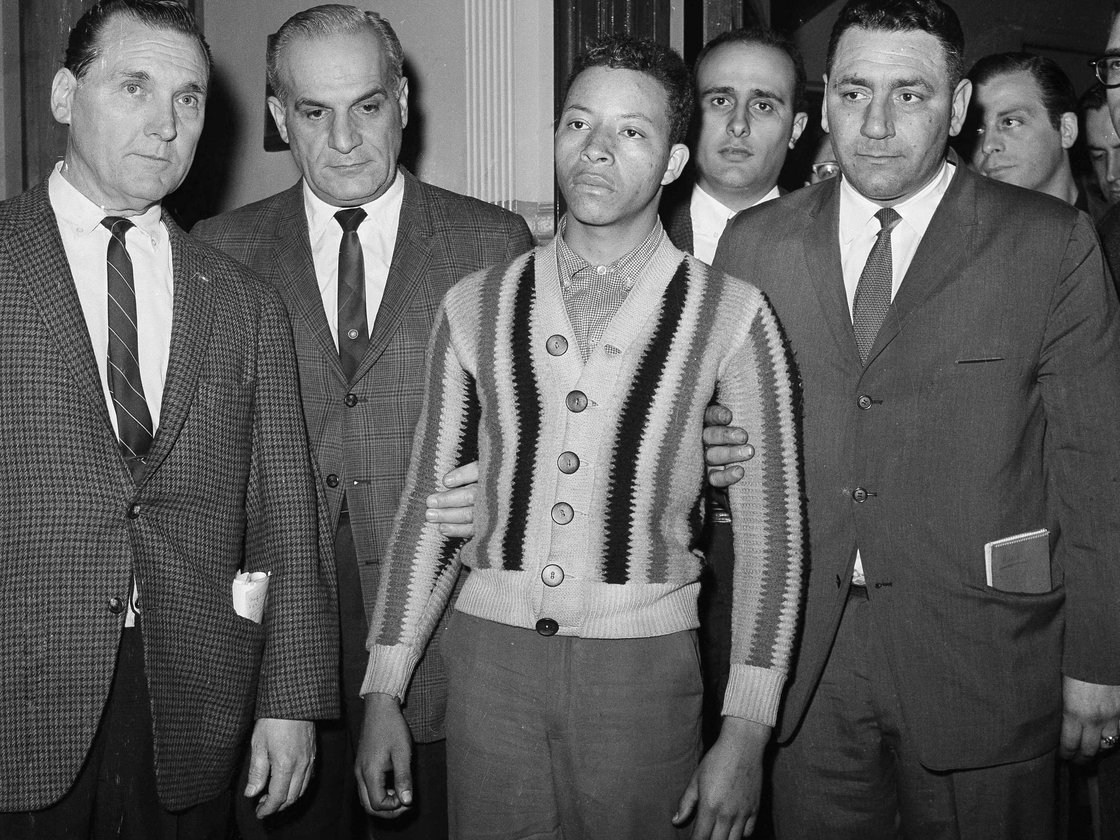
WhitmoreGeorge Whitmore, Jr. was standing in front of a Laundromat on Sutter Avenue just off of Amboy Street in Brooklyn. He was talking to a patrolman named Isola for the second day in a row. Only this time the patrolman arrived flanked by a detective, one who kept insisting Whitmore take a ride with them downtown.

Whitmore stood 5’5, 19, dark-skinned with pockmarked acne. He had been living in the Brownsville section of East Brooklyn for two years now … first with relatives, then on his own.

Whitmore was escorted to the 73rd Precinct, where he was asked to stand in front of an eyehole and repeat the following: “I’m gonna rape you, lady. I’m gonna rape you, and then I’m gonna kill you.” Unbeknownst to Whitmore, there was a sexual assault victim standing on the opposite side of that wall, and she emerged feigning hysterics, identifying Whitmore as the man who had assaulted her. Whitmore was held over for questioning, a 24-hour interrogation during which he was denied the right to an attorney, along with ongoing requests to submit his answers via polygraph.

At some point it became apparent that Whitmore was not only being questioned in connection with an attempted rape, but also a trio of homicides, two of which had occurred in an apartment on the Upper East Side. Whitmore maintained his innocence, insisting that not only had he never been to the Upper East Side, but that he and several others could account for his whereabouts throughout the day in question. Whitmore could be sure of it, he contended, because the murders took place on August 28th, 1963, an afternoon during which he was seated in a vast and empty catering hall at the Ivy Hotel in Wildwood, New Jersey, watching Martin Luther King deliver his “I Have a Dream” speech on a black-and-white TV. Continue reading

Aaron Swartz on Controlling The Means of Information In The Digital Age (2007)

“In the old system of broadcasting, you were fundamentally limited by the amount of space in the airwaves. You could only send out 10 channels over the airwaves for television, right? Or even with cable, you had 500 channels. On the internet everybody can have a channel. Everyone can get a blog or a Myspace page. Everyone has a way of expressing themselves. And so what you see now is not a question of who gets access to the airwaves, it’s a question of who gets control over the ways you find people. You start seeing power centralizing on sites like Google. These are sort of gatekeepers that tell you where on the internet you want to go, the people who provide you your sources of news and information. So it’s not only certain people who have a license to speak. Now everyone has a license to speak. It’s a question of who gets heard.”

(Excerpted From Steal This Film II)

IFB’s Quotations Page, General Index

On Roger Ebert and ‘Life Itself’ (The Book, The Movie & The Concept)


Ask any number of film buffs who the greatest movie critic of all-time is and 80% of them will answer Pauline Kael. Ask any number of average moviegoers that same question, and 75% of them will answer Roger Ebert. Ask any random sample of people from either group who the top three film critics of all-time are, and Roger Ebert will be the only name that consistently appears across both lists.

Therein lies his strength.

Roger Ebert is the everyman, the glutton, the philosopher and the drunkard. He is the Pulitzer-Prize winner and the terminal cancer patient. He represents the intolerable and the cherished, the physically handicapped and the triumphant, the down-but-never-out, the raging underdog within us. Roger Ebert is the barroom poet, the wise, old sage, the blue-collar hero and the hometown troubadour. He is the reporter, the author, the screenwriter and the satirist. He is the celebrity, the TV star, the loyal father, friend and husband. He is our champion and our legend. He is our worker and our icon.

Like most champions, Roger Ebert found a way of maneuvering over whenever circumstances prevented him from moving up. When he hit the ceiling of the newspaper business, he found a new gig on TV. When he bottomed out on television, he reinvented his celebrity online. When Ebert became physically incapacitated, he found a way to inhabit a more vivid space entirely, using the same four basic tools – his eyes, his ears, his brains and fingers – that got him hooked on this whole gambit to begin with.

The beauty of it was – and is – that the closer Roger Ebert came to passing, the more untethered he became in terms of what he would and wouldn’t write. His life, as it remains, represents nothing short of a symphony, the type of thing – much like his memoir – you can return to time and again, like a warm blanket or a handwritten letter. Roger Ebert fell into film criticism by accident and he wound up reimagining it as an industry. He stuck with the gig, he stuck with his woman, his woman stuck with him, and Roger Ebert stuck with us. No jaw, no voice, no problem – Roger Ebert’s got it covered. He went through periods during which he could neither sleep nor eat nor drink, and through it all he just kept writing, writing posts in brilliant spurts until two days before he died.

I think about this every now and again, as I have occasion to attend various film screenings around the city. These screenings, they take place in tiny cushioned rooms. Prior to the house lights going down, there is a great deal of one-ups-man-ship going on (“I find his work a bit pretentious,” “I sat next to her one night in Cannes.”). For the most part, I keep to myself. In a room full of critics with its even greater share of hangers-on, I lack the interest or initiative to discuss why I post my criticism via a very small personal website. My work is good. I know that. I see no need for name-dropping as a means of getting over. And yet I mention this because I routinely find myself scanning the room, yet lacking any urge to wander over and humbly compliment any critic on her work.

Vincent Canby is dead. Pauline Kael is dead. And so now, too, is Roger Ebert.

Cancer. Parkinson’s. Cancer, respectively.

The good news is Roger Ebert is once again alive up on the screen, in what can only be referred to as the most triumphant coup of his career. If you were a fan, and if, like me, you read Roger Ebert’s memoir, then you really should go see this documentary. If you weren’t a fan, or, worse yet, if you are completely unaware of Roger Ebert, that’s all the more reason you should buy the ticket, take the ride. I quote directly here from Roger Ebert’s Life Itself (the book and not the film): “The main thing wrong with a movie that is 10 years old is that it isn’t 30 years old. After the hairstyles and the costumes stop being dated and start being history, we can tell if the movie itself is timeless.” The same can be said for a life. And looking back upon more than 50 years of brilliant living, it is clear now, perhaps more so than ever, that Roger Ebert was – and is – a classic. He changed the way film marketing was done.

(Life Itself opens in limited release this Friday.)

A List of 32 Romantic Movie Cliches ‘They Came Together’ Gets Absolutely Perfect

  1.  “We open on an aerial shot of New York City”
  2. “It’s almost like New York City represents another character in our story.”
  3. “I know this might sound crazy”
  4. “What ever happened to just good, old-fashioned coffee?”
  5. “This is all happening so fast.”
  6. “No, I can’t.”
  7. The passing-of-seasons montage
  8. The trying-on-new-clothes montage
  9. The rabid-first-time-sex montage
  10. The waking-up-the-morning-after-totally-clothed scene
  11. The use of fake-real product names
  12. The carefree younger brother
  13. The asshole boss
  14. The illegitimate son who’s searching for a father figure
  15. The lousy rebound
  16. The nosy older sister
  17. The overbearing father-in-law
  18. The psycho ex
  19. The rival colleague
  20. The runaway bride
  21. The seductive mother
  22. The token black
  23. The two-timing fiance
  24. The well-meaning group of male cohorts
  25. The chance meeting in a bookstore
  26. The corporate walk-out
  27. The double date inside an intimate café
  28. The earnest advice
  29. The interrupted wedding 
  30. The New Years countdown
  31. The storybook romance
  32. The Hollywood ending

(Editor’s Note: They Came Together is a fun and fantastic and highly-recommended motion picture. It arrives in limited release and OnDemand this Friday.)

Christopher Nolan on Superheroes Vs. Batman

“Superheroes fill a gap in the pop-culture psyche, similar to the role of Greek mythology. There isn’t really anything else that does the job in modern terms. For me, Batman is the one that can most clearly be taken seriously. He’s not from another planet, or filled with radioactive gunk. I mean, Superman is essentially a god, but Batman is more like Hercules: he’s a human being, very flawed, and bridges the divide.”

IFB’s Quotations Page: General Index

Film Capsule: Snowpiercer


In this locomotive we call home there is one thing left between our warm hearts and the bitter cold. Clothing? Shields? No. Order. Order is the barrier that holds back the frozen death. We must all of us on this train of life remain in our altar’d station, we must each of us occupy our preordained particulate position. Would you wear a shoe on your head? Of course you wouldn’t wear a shoe on your head. A shoe doesn’t belong on your head. A shoe belongs on your foot. A hat belongs on your head. I am a hat, you are a shoe. I belong on the head, you belong on the foot.

That monologue – delivered by Tilda Swinton approximately 20 minutes into Snowpiercer – is one of several reasons why this film may be the most thought-provoking science fiction movie in years. Brilliant, bloody, inventive … Snowpiercer has a great deal to say about social structure, class, fascism, capitalism, theism, man-made atrocities, and why wars are being fought and lost over controlling the means of production. Korean director Joon-ho Bong includes fitting nods to Oldboy, 2001, The Matrix, Blade Runner, Children of MenThe Empire Strikes Back and Battle Royale (among others). Bong’s assembled a solid cast here, as well. Chris Evans (Captain America) is very good. Tilda Swinton (all things Wes Anderson) is even better. Octavia Spencer, unfortunately, not so much.

Anyway, the point being, Snowpiercer is a warm tonic for a bitter day. And it is highly recommended. So it is.

(Snowpiercer opens in limited release this Friday.)

Ranking James Toback’s Top 5 Motion Pictures

melodie-pour-un-tueur-tisa-farrow-harvey-keitelTwenty minutes into Nicholas Jarecki’s outstanding documentary The Outsider, Roger Ebert notes, “[Toback’s] typical picture is about a very smart guy who’s very hung up on sex, and often gambling. And because of the gambling, he gets in trouble with the mob.” While that statement may ring true, it is nonetheless remarkable to consider all Toback’s accomplished in that framework.

At 69, James Toback has taken on the role of a Svengali, a publicly-polarizing personality that simultaneously attracts people while repelling them. Toback is a Harvard grad, Magna Cum Laude, one-time editor of The Advocate. He’s given to addiction; he struggles with compulsion. As a student, Toback took hallucinogenic drugs to the near-point of insanity. As a post-grad, he hasn’t touched illegal drugs in years. He’s gained a reputation as a Lothario, a brilliant sloth who overcompensates by copulating. In terms of grandiosity, James Toback represents to the east what John Milius once represented to the west. The primary difference being that Toback took flight throughout the eighties, while John Milius dwindled off into the depths.

There is an honesty about James Toback’s work that can only be achieved via directors who insist upon writing – or adapting – their own screenplays (Stanley Kubrick, Woody Allen and Quentin Tarantino come to mind). That sense of ownership tends to keep directors taut, willing to campaign for what is true and right and necessary about their work. James Toback, in particular, has never made a film I didn’t happen to enjoy. In certain cases, this might’ve been due to something as simple as a mechanism or a moment (e.g., Harvey Keitel carrying the entire soundtrack under his arm throughout Fingers or Neve Campbell acknowledging the camera toward the end of When Will I Be Loved). In other cases, I might’ve hooked into some riff regarding god or love or sex and death. Either way, the fact remains there are only a handful of directors who can pull off such a feat, and fewer still who can somehow manage it without the benefit of 60-mil. And so here now, in that spirit, is my list of the top five motion pictures Mr. Toback’s ever made:


5. Harvard Man (2001): In the same way surgeons are cautioned against operating on their own children, James Toback might’ve needed to take a step away from this semi-autobiographical motion picture. The lead character, played by Adrian Grenier, is a cunning, super-intelligent, totally selfless Harvard athlete who just so happens to be “the greatest fuck in the world”. The names have changed but the implication remains the same – James Toback considers himself to be a golden god, and he would like it very much if you would recognize that, too. Heidegger, Kierkegaard, sex, drugs, gambling and transcendence … Harvard Man is consumed with the quaint art of pleasure, and the desperation that occurs when one pursues it all too freely.

Notable Members of the Ensemble: Joey Lauren Adams, Ray Allen, Al Franken, Sarah Michelle Gellar, Adrian Grenier, Gianni Russo, Eric Stoltz.


4. The Pick-up Artist (1987): There is this girl that I am in love with, and the rub of it is, this girl (whatever, woman) wants very little to do with me – a dynamic which I find distressing. Anyway, I think about this person whenever I happen upon The Pick-Up Artist, specifically toward the end when Molly Ringwald’s Randy (I mean, c’mon) insists to Robert Downey’s Jack, “I’ll always be grateful to you, but we’re not good for each other.”

The Pick-Up Artist is far from ideal. The dialogue is cheesy and the plot’s forever bordering on absurd. What’s more, the movie represents an exploration of what the majority of people find significantly off-putting when it comes to Mr. Toback. And yet despite that, there is a tremendous amount of charm gracing this picture, the kind that one experiences from watching Robert Downey woo an 18-year-old film star. Assuming all of Toback’s work represents some extension of his id, one might assume his biggest challenge isn’t so much meeting – or mating with – exceptional women, but getting them to stick around. The Pick-up Artist succeeds because it focuses on setting all that weak-ass shit aside, disposing with machismo in the hopes of something more.

Notable Members of the Ensemble: Danny Aiello, Victor Argo, Lorraine Bracco, Robert Downey, Jr., Dennis Hopper, Victoria Jackson, Harvey Keitel, Fred Melamed, Molly Ringwald, Tony Sirico, Robert Towne, Vanessa Williams.


3. Exposed (1983): Here we are confronted by a classic Toback tenet – the notion that great men regularly pursue and approach hapless women on the street, determined to have some profound, life-altering, impact on their being. It’s a silly preoccupation, one that Toback has attempted to push by for years. Only it’s nonsense, an exhausted plot device that often serves as a distraction.

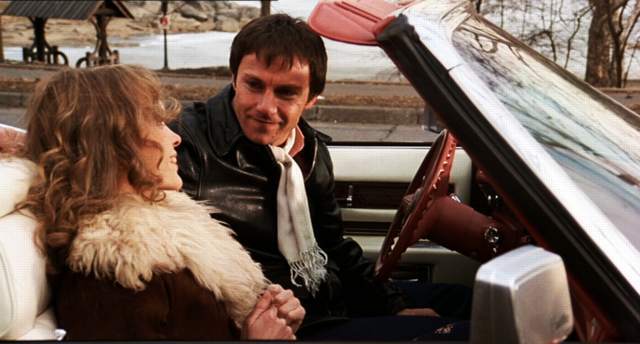
There are several Toback staples in this movie, including (but not limited to): a classically-trained musician, 1950’s rock n roll, a sexual dalliance involving an academic mentor, and a brief appearance by Tony Sirico. Exposed unfolds with all the drama of a British crime thriller. Goethe, Nietzsche, fear as a catalyst for change … in Toback’s philosophical dystopia, beauty equal access, and vanity, a fatal flaw. That theme plays out exquisitely, thanks in large part to Natassja Kinski and (Toback stalwart) Harvey Keitel.

Notable Members of the Ensemble: Janice Dickinson, Stephanie Farrow, Pete Hamill, Iman, Harvey Keitel, Natassja Kinski, Norris Mailer, Ian McShane, Rudolf Nureyev, Tony Sirico, James Toback, Jose Torres.


2. Tyson (2008): During a 2013 Hollywood Reporter roundtable James Toback calmly stated, “I think anyone who today still feels that fiction films are competitive in terms of depicting the human condition with documentary – all other things being equal in terms of quality – has his head lodged so firmly up his colon that he should find a crane to remove it.” While Toback was on the scene to promote Seduced and Abandoned, he was also referring to a latter-day shift in his career, one that has seen him put out two feature films in the span of six years, both of them documentaries.

In the case of Tyson, Toback was dealing with the same basic building blocks Nicholas Jarecki had when approaching The Outsider (i.e., a captivating public figure who surrounds himself with controversy). Toback never set out to create another “Iron Mike” retrospective, and, as a result, his portrait remains the most humane of all the Tyson documentaries. There is no veneer, no filter, no sudden cuts to Bert Sugar chomping on that fat goddamn cigar. As Toback himself put it a year prior to the film’s U.S. release: “Ultimately, the truth is, who gives a fuck what Teddy Atlas has to say about Mike Tyson? Or, for that matter, who cares what any number of people who’ve written about him or talked about him have to say? It’s an opinion, and not one that has even an iota as much interest – at least to me – as listening to Mike and watching Mike. So I just thought, Why clutter up a chance of a lifetime to do a riveting portrait of a riveting figure by introducing a lot of third-rate garbage?

Well put, Mr Toback. And exceedingly well-executed.

Notable Members of the Ensemble: Mike Tyson


1. Black and White (1999): Black and White is the most Tobackian of all James Toback’s movies. It is consumed with orientation, race and culture, one side exploiting the other to achieve its own selfish end. The white kids want to be gangsters, the black kids want to be capitalists, and every group continues feeding off the lifestyle it abhors. Black and White is the story of urban life in America, featuring completely out-of-body turns by Elijah Wood, Brooke Shields, Claudia Schiffer, Robert Downey, Jr., Bijou Phillips and a plethora of others. The most memorable moment? A frustrated Mike Tyson bitch-slapping Robert Downey, Jr. to the floor. “We still don’t know if it was fake or not,” producer Hooman Majd insisted during an Interview Magazine Q&A. Either does the audience, and that’s why it continues to feel so incendiary.

Notable Members of the Ensemble: Scott Caan, Robert Downey, Jr., Ghostface Killah, Gaby Hoffmann, Hassan Johnson, Michael B. Jordan, Jared Leto, Marla Maples, Method Man, Joe Pantoliano, Bijou Phillips, Raekwon, Brett Ratner, Claudia Schiffer, Brooke Shields, Ben Stiller, James Toback, Mike Tyson, Elijah Wood, Chuck Zito.

George Plimpton on The Difference Between Professional Sports & Orchestral Synchronicity (1968)

“I am often asked which of the participatory exercises I have been involved in was the most frightening. People are always startled when I say the one that frightened me the most was not playing football with the professionals, or basketball, or boxing, but when I played with the New York Philharmonic.

I played the triangle. And some of the other percussion instruments.

One reason it was terrifying was that in music you cannot make a mistake. Almost all sports are predicated on the concept of an error being a determinant in the outcome: in tennis you put a twist on the ball in the hope your opponent will make an error; in boxing you feint and hope the other fellow is going to drop his guard so you can pop him; football is an immense exercise in trying to get the other people to make mistakes – not to be where they should be.

But in music you cannot make a mistake. It is not part of the zeitgeist. If you make a mistake, a big one, you destroy a work of art. The thought of doing this nags, of course, at the consciousness of all musicians, even the very good ones. In the rehearsal rooms of the great concert halls the musicians getting ready for an important concert have that same glazed look I have seen on the faces of professionals going out to face the Chicago Bears. In fact, I got to know a violinist with the Philharmonic who told me he was so frightened of making a mistake – especially in rehearsals, where the conductor can stop everything and glare at you and point out that it’s a B-flat not a B – that he toyed with the idea of putting soap on the strings of his violin so that when he played it hardly any sound would emerge off it. The idea was to do this until he got a surer sense of where he was – got his confidence.

(Excerpted from The Best of Plimpton)

IFB’s Quotations Page, General Index

Film Capsule: Third Person


Woody Allen once referred to Liam Neeson as being “incapable of a graceless moment in front of the camera.” Over the past several years, Liam Neeson has put that theory to the test. Starting with The A-Team, up and through Battleship, and now as the lead in Paul Haggis’s forthcoming Third Person, Neeson – perhaps the most affable screen presence on the planet – continues to place himself in roles that scar his credibility. And yet the beauty of it is the 62-year old actor’s quote somehow still manages to rise, almost in spite of all the lackluster material.

More confounding in the case of Third Person is Paul Haggis, a writer and director as historically uneven as his very public background. Haggis, a former scientologist who also published the most scathing insider account of that religion, wrote Casino Royale, one of the best Bond films of all-time, before going on to write Quantum of Solace, universally regarded as one of the worst. Haggis wrote and directed Crash, the most overachieving motion pictures of all-time, before going on to write and direct In the Valley of Elah, one of the least. Haggis is in, he’s out. He’s up, then down. And so now he’s finally come full-circle, directing yet another film-as-collage, one that lacks the smooth cohesiveness of Crash, if not the truth it seems so desperate to unravel.

The lead character in Third Person (played by Neeson) is an aging writer, living vicariously through the mishaps of his characters. In reality, this is Haggis on Haggis, a writer writing about a writer who seeks redemption through his plot valves. As an audience, we’ve seen this entertainment before, sinners working out life problems in the hope of being born anew. While there are moments of great clarity and tension (including one particularly gripping sequence involving James Franco and Mila Kunis) Haggis largely squanders a first-class acting troupe on what amounts to several one-acts. There are common threads connecting one piece to another, yet for the most part this is a case of Haggis returning to his once-prosperous well. Third Person is a dramatic-romantic-comedy (a drom-com?) that ultimately descends into absurdity. A trio of relationships, each of them complicated by some echo from the past. Confront the echo, remove the thorn. It’s 137 minutes worth of tedium featuring 45 seconds worth of Olivia Wilde, naked as a jaybird, parading around the halls of a hotel.

(Third Person opens in limited release this Friday.)