
“I think anyone who today still feels that fiction films are competitive in terms of depicting the human condition with documentary – all other things being equal in terms of quality – has his head lodged so firmly up his colon that he should find a crane to remove it. This almost gruesomely embarrassing talk about digging deep into one’s so-called soul to get performances of truth, moments of truth, in fiction films, and brave performances … I always think of coal miners when people talk about brave performances. What bravery does it take? I mean, it’s not happening, it’s not real. And if the goal of documentary moviemaking is to show some form of truth – and if you’re dealing with people, psychological truth, personal truth, emotional truth – it’s something you’re never getting more than a glimpse of in a fiction film. I still like movies, and I want to make some of them, but I think every year it becomes more and more apparent that it’s embarrassing to compare the two. The documentary has advanced so far beyond, and the movies that are of interest are numerically so heavily weighted in the favor of documentary, despite the fact that 99% of the money is spent making fiction films, most of which are not worth watching. We’re in this sluggish environment in which still that’s where all the attention is paid, or most of the attention, most of the emphasis. And there’s this world of fascinating, terrific stuff that’s being made all the time, in the theaters, on the television. I could spend my life just watching one interesting
nonfiction film after another.”
Author Archives: BobHill
Galleria: Balthus: Cats & Girls @ The Metropolitan Museum of Art
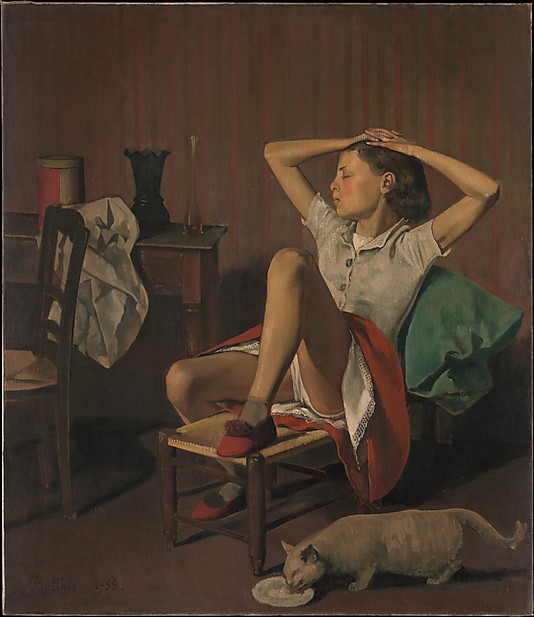 It’s a funny thing about the French painter Balthus, in that he nearly gave up his budding career out of frustration. When Balthus reemerged at the age of 25, he focused almost entirely on portraits – lurid, filthy, decadent portraits. His favorite subject, perhaps even his muse, was a prepubescent neighbor by the name of Therese Blanchard. Blanchard (illustration at right) posed for nearly a dozen well-known Balthus paintings, all of them between the years of 1936 and ’39 (at which point Balthus got called up for military duty). After the war, Therese Blanchard – who was now teetering on the brink of adulthood – disappeared from Balthus’ work entirely.
By 1950, Balthus had become an international sensation, his work championed by the likes of Matisse and Fellini. Therese Blanchard, on the other hand, was dead … plucked at the very same age as Balthus when he originally began painting her. Perhaps this is one of several reasons why visitors feel inextricably drawn to the “Therese” gallery of Cats & Girls. For it is inside this gallery, much more than any other, that one gets a sense of both the exploitation and the provocation that still render Balthus’ work worthwhile.
(Balthus: Cats & Girls continues at The Metropolitan Museum of Art through this Sunday, January 12th. Free with suggested donation.)
Five More For The Offing:
- Be Fabulous by Roxanne Lowit @ Steven Kasher Gallery (Free, through 1/12, 521 West 23rd Street)
- The Last Studies by Balthus @ Gagosian Gallery (Free, through 1/18, 976 Madison Avenue)
- American Legends: From Calder to O’Keefe featuring various artists @ The Whitney Museum ($20 general admission, through 10/19, 945 Madison Avenue @ 75th Street)
- The Mystery of The Ordinary by Magritte @ The Museum of Modern Art ($25 general admission, through 1/12, 11 West 53rd Street)
- The Image Gallery Redux featuring various artists @ Howard Greenberg Gallery (Free, 1/9-2/15, 41 East 57th Street, Suite 1406)
I’ll Stop The World (& Melt With You)
Related: “The Snow” (2013)
(Good Pictures/Bad Camera is a regular feature on IFB.)
Steve Jobs on The Real-Life Application of Video Games (1990)
“I remember the video game phenomenon, probably all of you do too. The most interesting thing about the video game phenomenon to me was that within a few years after its beginning, kids and non-kids were putting two-and-a-half billion dollars worth of quarters into these things a year. You can look at these things as games and dismiss them. Or you can look at them as very simple simulated learning environments. So, as an example, in a simple pong game, the game is constantly telling you how well you’re doing by how well you score. And so the more you learn the underlying principles, the better you score. The underlying principle in the case of most of these games was fairly simple, but carry that concept much further: imagine if the underlying principles are a sophisticated macroeconomic model of how France might’ve functioned in the time of Louis XIV. This type of simulation then becomes a little less trivial than the video game, and yet the principles are still the same. And you can imagine what it would be like if we could use the historical material in the Library of Congress coupled with the interactive computer technology that we’re developing to do these things. These simulations would become what most of our students are learning from.”
IFB’s Top 10 Movies of 2013
10. Out of The Furnace
There’s the good guy with a gun and the bad guy with a gun. Only justice is blind and the world is ambivalent.
9. Gravity
The most brilliantly executed movie about space since Stanley Kubrick’s 2001.
8. Side Effects
A deep meditation on the human stain of pharmaceuticals and mental illness, featuring Rooney Mara in the most understated role of her career.
7. Mud
The McConaissance continues.
6. Captain Phillips
The first 10 minutes of Captain Phillips feel unsettling and earnest, with (screenwriter) Billy Ray telling a lot of the things he’d be much better showing. But Captain Phillips hits its mark from that point forward, thanks in large part to an ongoing lack of grandstanding. Tom Hanks is very good, but Barkhad Abdi steals his thunder.
5. Spring Breakers
A gorgeous, rhythmic, candy-colored tragedy. Spring break. Spring break. Spring break, forever.
4. Frances Ha
Perhaps every generation should have its very own Manhattan.
3. Inside Llewyn Davis
One of several key differences between a good movie and a great one is that a good movie may entertain you for two hours, providing a variety of twist and turns, but a great one’ll stick with you for a lifetime, revealing untold secrets every time you play it over.
2. American Hustle
David O. Russell doing his best Martin Scorsese.
1. The Place Beyond The Pines
A vastly overlooked motion picture focusing on fathers and the inevitable – sometimes even inescapable – legacies they hand down to their sons. The most unexpected surprise occurs about a third of the way through. From that point forward, this triptych only grows much more intriguing.
11 Reasons Why Oliver Stone’s ‘Wall Street’ Is More Entertaining Than Scorsese’s ‘Wolf of Wall Street’
- Gordon Gekko is an incredibly likable egomaniac. Jordan Belfort is just an egomaniac.
- Wall Street is a fictional story that feels vital and real. The Wolf of Wall Street is a factual story that feels passe and hyperbolic.
- With a running time of 126 minutes, Wall Street feels incredibly tight. With a running time of 180 minutes, The Wolf of Wall Street feels unnecessarily laborious.
- Gordon Gekko’s “Greed is Good” speech will always feel iconic. Jordan Belfort’s “Land of Opportunity” speech will always feel sardonic.
- Most of the characters in Wall Street are pursuing their own sense of class. Most of the characters in The Wolf of Wall Street are pursuing their own sense of flash.
- Whereas Bud Fox and his father seem well worth rooting for, The Wolf of Wall Street offers no major characters worth rooting for.
- The Wolf of Wall Street is guilty of employing a variety of bush-league winks, including a brief cameo by the real Jordan Belfort (portraying someone else), an equally brief cameo by Fran Lebowitz (portraying someone else), and a pair of passing references to Gordon Gekko and Bud Fox.
- Whereas Oliver Stone’s original screenplay actually elevated the performance of Charlie Sheen, Terence Winter’s bloated adaptation equally diminishes a stellar turn by Leonardo DiCaprio.
- You never get the sense that Jordan Belfort is going anywhere but down, and – what’s infinitely worse – you never really seem to care.
- Wall Street ends like a movie that delivers on its promises. The Wolf of Wall Street ends like a movie that ran out of financing.
- Wall Street feels like the ambitious work of a young director on the way up. The Wolf of Wall Street feels like the overwrought work of an aging archetype facing decline.
(The Wolf of Wall Street is currently playing in theaters nationwide.)
MERRY CHRISTMAS!
Surprise someone today.
Hilton Als on Memory, Misremembered (2013)
“The wall surrounding memory misremembered is clean and wide and high, similar in effect to the wall one finds in certain airports in other countries, clean and wide and high like that, banking in or letting go those who want to remember clearly or don’t. Passengers coming or going in the field of memory are a tangle of arms and legs, hands, hearts, hair, and minds that – if you do not stand too close or listen too carefully – speak a shared language, remarkable in its oppressive loneliness, its denial: What a horrible memory, and so forth. Regardless of where many of us believe we land – in that field encumbered by not too much baggage or entirely too much – we all come from the same place, which is a road rutted by experience so banal, nearly remarkable, that memory tricks us into remembrance of it again and again, as if experience alone were not enough. What are we to do with such a life, one in which we are not left alone to events – love, shopping, and so forth – but to the holocaust of feeling that memory,
misremembered or not, imposes on us?”
IFB’s Top 10 Posts of 2013
 IFB Presents: 7 Classic Springsteen Stories That Are Well Worth Mass Retelling
- 19 Reasons Why 6 Souls Is The Absolute Worst Movie Julianne Moore Has Ever Agreed To Be a Part Of
- Moving On: The Year of Losing Dangerously
- IFB Presents: The Top 20 Recurring Characters from AMC’s Breaking Bad
- Film Capsule: What Maisie Knew
- Good Pictures/Bad Camera: This Is Wildwood, New Jersey
- Moving On: Every Road Leads Back to Wildwood
- Why Laura Marling May Very Well Be The Most Important Folk Artist To Come Along in 40 Years
- Moving On: The Vacationer
- Good Pictures/Bad Camera: The Fog

Good Pictures/Bad Camera: The Very Best of 2013
(All 2013 images taken with a Canon PowerShot A1300 digital camera.)
(Good Pictures/Bad Camera is a regular feature on IFB.)